I hadn’t heard, read or dreamt about the term Aurora Borealis or Northern lights until my first visit to Norway (this might have been one of those topics I missed in afternoon Geography classes at school while I was busy 😴😴). I was on my first business (training) trip to Norway in 2007 when my colleague, Kristian Albrigsten showed pictures of this phenomenon taken at his hometown Tromsø (pronounced Trom-so). I initially thought Kristian was joking and the colours in the sky was his creativity in photoshop. Later I took a copy of those pictures, made it my desktop wallpaper, noted down its name and started googling.
Wikipedia knows a lot about it! I desperately hoped to see it one night and I remember a lot of late nights (on many other trips too) that I tried to step out of the hotel room or apartment in Kongsberg and stared at the sky, trying to locate Aurora. The homework wasn’t done good enough then.
Misconception 1: Aurora activity happens every day and can be seen even from Kongsberg (south of Norway) on a clear sky night.
Misconception 2: I have to be extremely lucky to be able to see it.
When we moved to Norway, this item was definitely on top of our wish list. I started googling the most obvious questions:
- Aurora borealis in Norway (what)
- Best time to see the northern lights (when)
- Best location to view the northern lights (where)
- Best techniques to capture the northern lights (how)
For each of these questions, google gets back to me with millions of results within a fraction of the second. When I last tried, first search query returned with approx 3.83 millions results in 0.5 seconds! After doing better homework this time, I started planning a trip to see Aurora.
These are some of the key factors that I used for planning:
Location: Aurora activity in the sky happens closer to the poles (north & south). Closer we get to these poles, higher the chances of seeing it and that too over your head! From far locations, you may be limited to viewing only in the horizon (like Kongsberg). So I fixed Tromsø as my destination. I believe it should be OK to try anywhere within the arctic circle.
Viewing spot: Any spot away from areas with light pollution is good for viewing. This can be on top of a mountain, by the sea shore or by a fjord with a good view towards North. I didn’t enquire or book any tour guide. Taking such tours with young kids along can be troublesome. So, I decided to book a cottage away from the city where my wife and I could step out and watch Aurora while the kids were sleeping inside. Ersfjordbotn seemed be one of such places around Tromsø with a beautiful fjord and it also turned out to be a popular spot for whale watching.
These two factors (location and spot) can be pre-selected and investigated for all other practical purposes.
Season: Summer is too bright and out of question. I have been reading that late Autumn and early Spring is the best time for viewing. This could be based on historical statistical data of various environmental factors. This means that September / October and March / April are considered to be the months with highest probability for viewing. However, Aurora can be viewed from November to February as well.
Luck factor comes into play when the travel date is planned well in advance. My choice was not to go by the season, but plan everything in advance and decide a date (last minute booking) between October and March when other factors are favourable, as seen in short term forecast. This can make the whole trip more expensive but increase the chance of viewing. There is always a trade-off / risk to take when booking is done in advance vs last minute booking.
Weather: You definitely need a clear sky for a good viewing. Aurora cannot be seen under cloudy conditions. Colder night is better as the sky tends to be clearer during cold nights. Having a night with completely clear sky can be a bit challenging. This is where the profession tour guides know the trick well. They know the best locations for viewing Aurora and most importantly know how to read cloud movements and predict spots for clear view. Remember that weather predictions can easily be proven wrong, especially in fragile conditions like the arctic circle. Luck!!
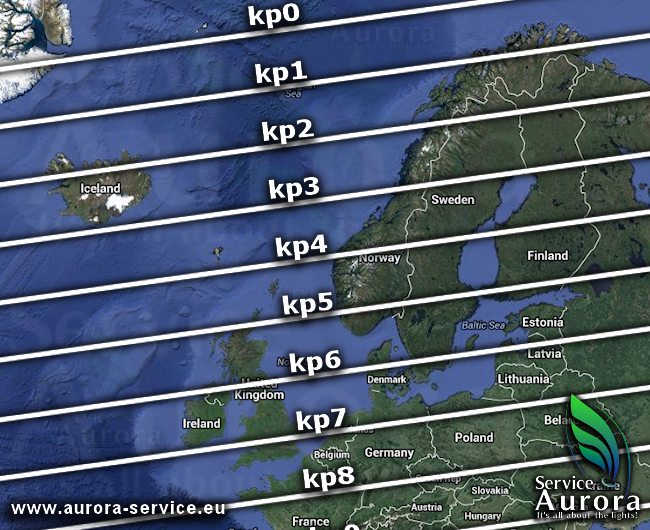
Kp Index: Kp number is a scale of the geomagnetic activity. This predicted number gives a rough estimate of strength and visibility range of Aurora. Also, this helps to decide a location outside the arctic circle if Kp number is very high. This link gives a lot of info and better explanation about this and more factors like solar activities and related measurements.
I figured out that a Kp index of 3 and above is a good starting range, for hope.
Moon: I read on a discussion forum that it is possible to see Aurora even on a full moon night. I preferred a dark night with no moon for getting good contrast in photos – dark sky, shining stars and AURORA!!
In addition, a very important factor is YOU. You need to show a lot of patience (which I lack in most times) and be well prepared with appropriate clothing and protection gear against the cold. If you plan to do some photography (of course, this deserves to be shared and celebrated on social media!), smart phones may not be sufficient and I strongly recommend reading this extensive article on the topic.
I kept a regular check on all these factors with respect to Tromsø (as a favourite) and couple of other locations. On a Wednesday (week 4 – end Jan) evening, I noticed favourable factors predicted for that weekend:
- Weather: Clear sky all through the weekend starting Friday.
- Kp Index: The prediction was 5 for Friday night and 3 for Saturday. First night with very high chance and second one with decent hope.
- Moon: It wasn’t a no moon night, but, the moon didn’t rise until 01:40 which gave the same result as a no moon during the most probable viewing time (18:00 to 01:00). Good to check the moon calendar too.
Without further thoughts, I booked the flight tickets to Tromsø and cottage at Ersfjordbotn. We rented a car since the cottage was far from the city, 25 minutes drive (west) from the airport. Our flight from Oslo was delayed over an hour and we reached the cottage in Tromsø by 01:00 on Saturday. We narrowly missed the nature’s show on Friday evening by an hour. All our hopes were for Saturday evening (!!).
We spent that day visiting the city and popular tourist spots in Tromsø. We had also scouted for a better viewing spot since our cottage has a big mountain right behind it on the northern side and the view towards the fjord was to the west. After few minutes of drive from Ersfjord, we stopped at a place called Grøtfjord Bygdelag and waited from 18:30. The conditions were still favourable for viewing: temperature about -12 degC, strong winds and clear sky.
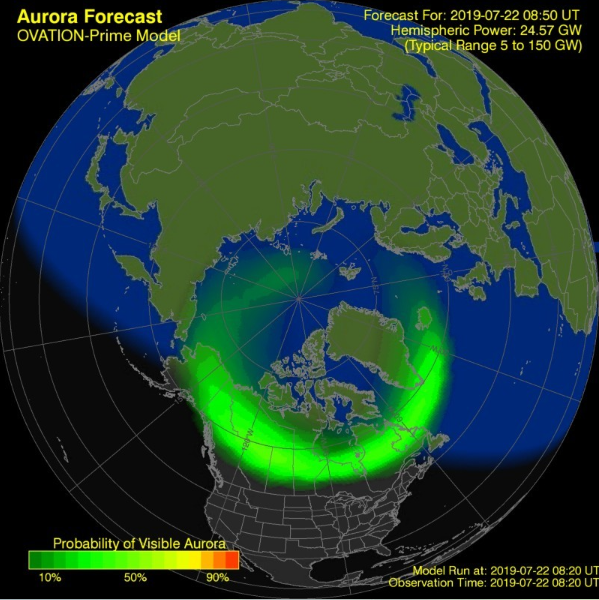
I started observing the Aurora prediction – ovation model. The green lights represents the aurora ring, probability of visible Aurora and prediction of its current position. We had to wait until the bright portion of the ring revolves and came over Norway (our head). Close enough to the prediction, we started seeing some lights appearing on the northern sky. Initially, Aurora appeared as white shades in the northern sky and slowly it started to get stronger and brighter. Capturing those lights with my DSLR (approx 20s exposures) showed the green colours more evident than seen with naked eye. Yes! our prediction and prayers worked! We didn’t return to Kongsberg with disappointment.
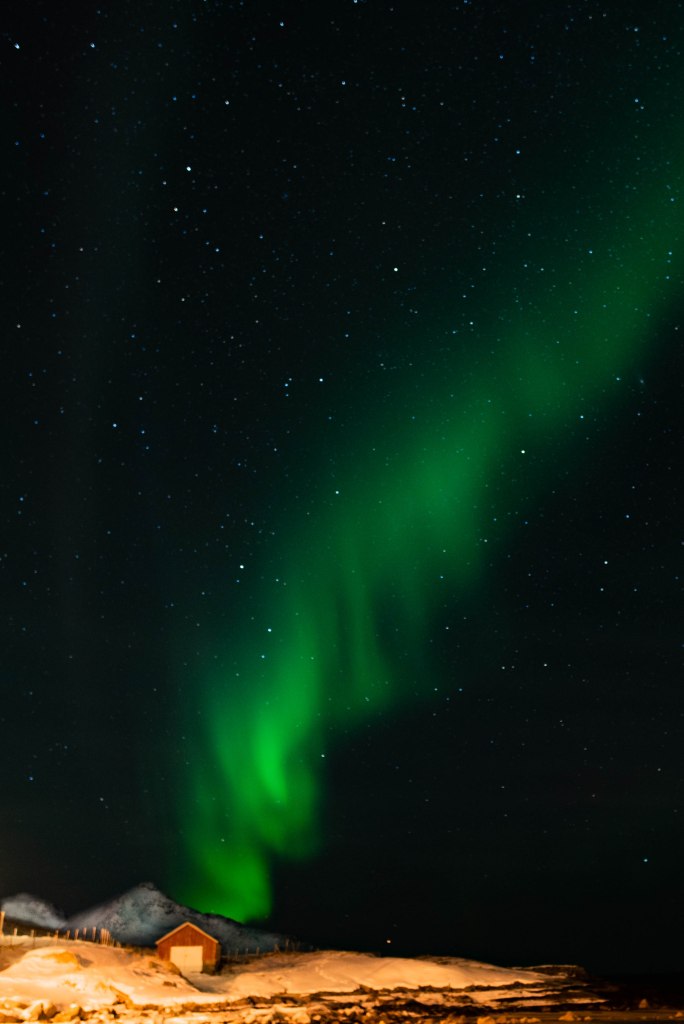
This marvellous phenomenon or sight can be scientifically explained as a reaction from solar particles entering earth’s atmosphere at a particular altitude or as a blissful show of THE CREATOR’s art work. I prefer to call it the latter!
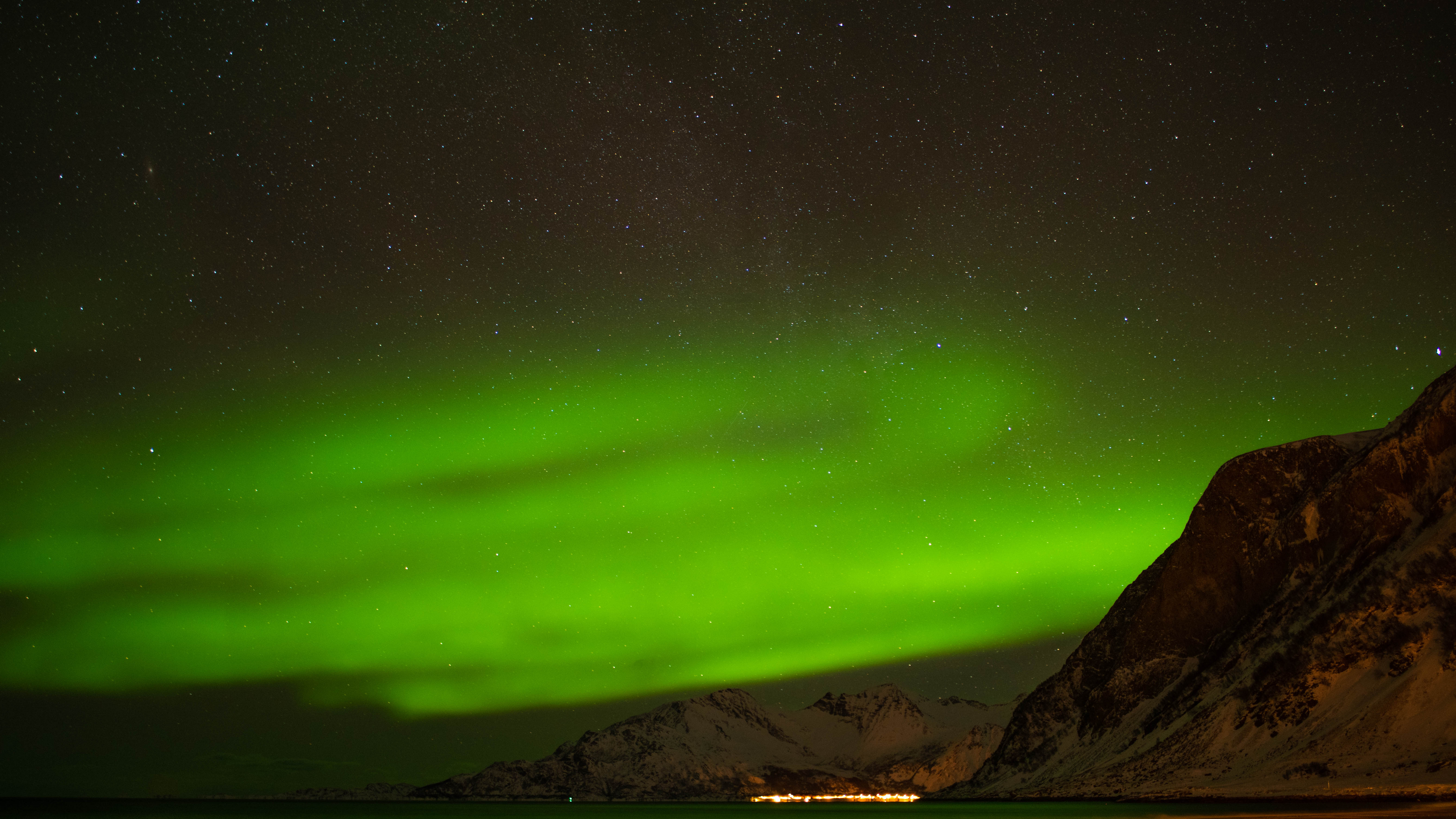
I’m not a subject matter expert and this article is just summing up my little study of the topic from various sources available in the internet. There could be a lot more topics factoring the chances of viewing northern lights, but the ones I have listed above were the ones I used and (luckily or not) it helped.
Good luck with Aurora hunting! 😀
 Life is a Journey..
Great post 😁
LikeLike